



TLDR
The Attention Factory is a proposal for AI systems that can show what they currently support, what evidence supports it and what they could not observe.
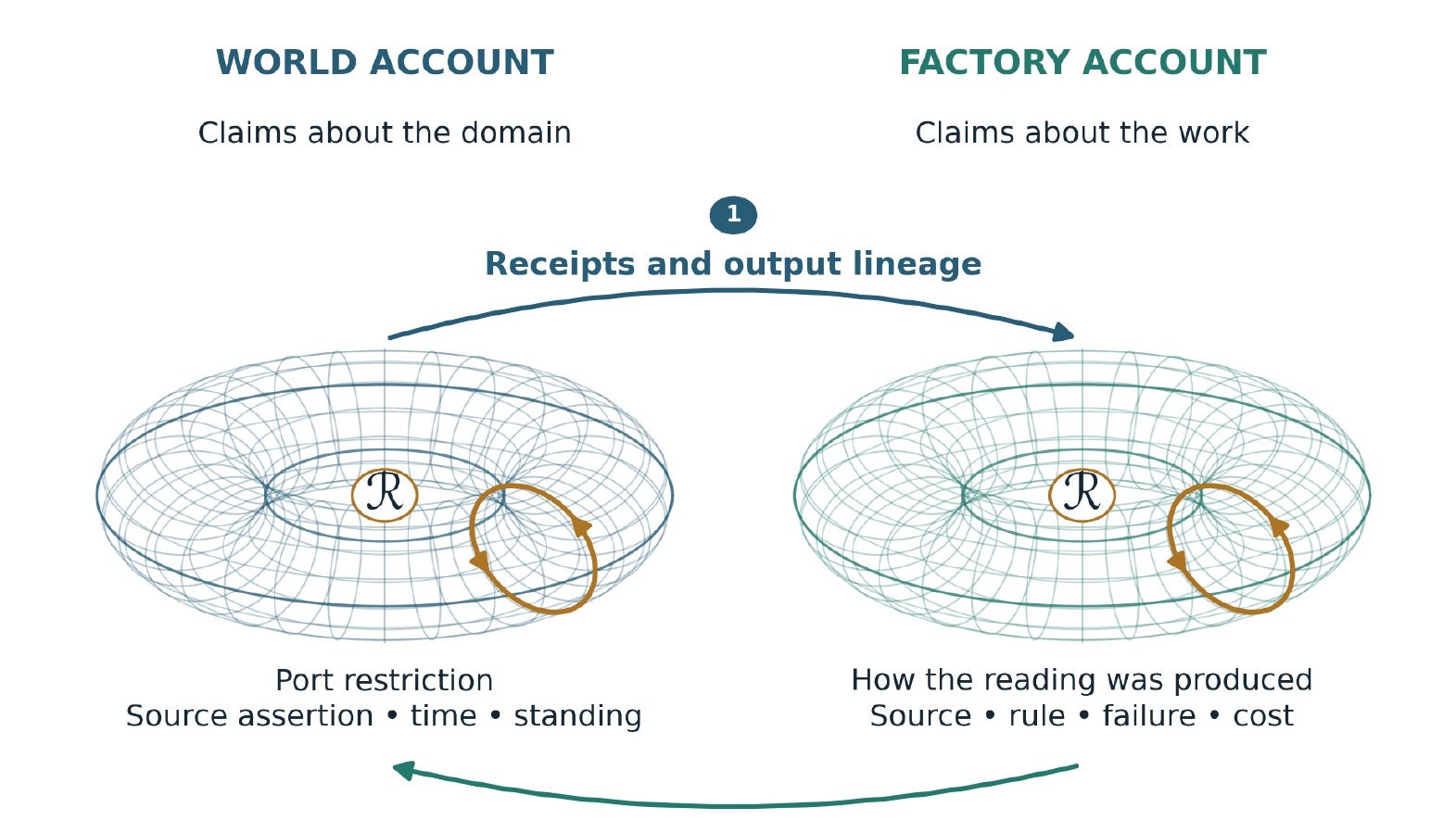
It maintains two adjacent accounts: a world account of claims, evidence and relationships, and a factory account of the work, rules, failures and costs that produced them.
Its purpose is not greater AI confidence. It is inspectable uncertainty, correction and accountability.
Its first serious test is practical: Can a correction reach every affected output, preserve the earlier reading and distinguish missing evidence from evidence of absence?
Status: This introduction is based on The Attention Factory, version 6.2, dated Sept. 24, 2026. It proposes an architecture and evaluation contract.
Earlier AI Theory essays examined individual orchestration, institutional memory and collective coordination. The Attention Factory carries that inquiry into maintained understanding: how evidence becomes an answer, how that answer changes and how the system accounts for both.
Read
An AI agent can discover a defect, propose a fix, run tests and write a confident summary. Then the session ends. The next agent may not know what happened, why the decision was made or where the risk remains.
That is not merely a limitation of a single model. It is a design problem for any system that depends on finite, fallible and changing intelligence.
The same problem appears outside software. A system may report that a port is closed, a policy changed or a company is exposed to risk. But a polished answer can hide the facts that matter most: whether the source was primary, whether the claim was later corrected, whether another source was unavailable, whether the result is suitable for this consumer and whether the system can reproduce its work.
The Attention Factory begins with a simple proposition: Understanding should be maintained as an inspectable process, not delivered only as an answer.
This extends a lesson from AI-Native SDLC. Stateless AI workers need durable memory outside the worker. In software, that memory can live in repositories, issues, pull requests, tests and operating rules. For a system that maintains understanding of a domain, the same discipline must apply to evidence, relationships, corrections and decisions.
The stakes are growing because AI gives individuals and small teams more production capacity than they could previously command. As The Greenfield Below argues, the opportunity may be expanding below the traditional organizational layer. But more output does not solve the problem of trustworthy attention. It makes that problem more important.
The AI-Native SDLC Companion adds an operational corollary: A failure should leave behind a durable lesson rather than only a patch. The Attention Factory applies that discipline to maintained understanding.
Explain
The Attention Factory maintains two related accounts.
The world account contains what the system currently maintains about an external domain: addressable subjects, observations, claims, events, relationships and their standing.
The factory account contains what the system can support about its own production: sources used, transformations performed, rules applied, access failures, evaluation results, resource costs and correction paths.
The distinction is essential.
If a source stops updating, that is useful information about the factory’s ability to observe. It may change where the system looks next. But it does not, by itself, establish whether an external event happened.
At the center of the proposal is a rule for constructing a relationship with a receipt. The paper calls this a versioned relational constructor. In plain language, it creates a proposed relationship from identified inputs, assigned roles and declared context while preserving the evidence and rules that made the relationship possible.
A source reporting a port closure is not the same as evidence that the port is closed. The source, its statement, the asserted event, the date, the governing rules and the uncertainty all need to remain distinguishable.
That makes a more honest answer possible.
Instead of collapsing the world into “true” or “false,” a conforming implementation could say: This was reported; this evidence supports it; this evidence conflicts with it; access to a relevant source failed; the claim is not currently suitable for reliance; or the answer should be reconsidered.
The system’s continuing observation contracts are called Watches. A Watch defines what matters to a particular consumer and what service the system undertakes to maintain over time.
The same underlying evidence may support different Watches without requiring separate evidence stores. A ship operator may need to know whether a route is navigable now. An energy analyst may need to understand the future effect of a proposed restriction. The evidence can be shared. The purpose, permissions, time horizon and form of the reading can differ.
“An access failure does not establish absence.”
— The Attention Factory
Illustrate
Consider a simple correction.
At 9 a.m., a source reports that Port Alder is closed. The system retains the report, constructs the stated closure relationship and records the basis on which the claim may appear in a Watch.
At 9:05 a.m., the Watch emits an attributed reading with the relationship’s version and source dependency.
At 10 a.m., the source corrects the report. The restriction applies only to vessels above a stated draft. The port remains open to others.
A weak system may overwrite the first answer and move on. The current answer may look cleaner, but the system has lost the record of what it knew at the time, what it said and why it changed.
The Attention Factory instead proposes preserving the earlier record while changing its current standing. A dependency index identifies the affected reading. The broader closure claim is withdrawn from current reliance, the narrower restriction is constructed and assessed, and the next Watch output explicitly corrects the earlier conclusion.
Replay at the earlier knowledge cutoff would still show the earlier report and decision, even though both are now known to have been wrong. A retrospective analysis using the corrected source is a different operation and must identify its later knowledge cutoff.
That is not a promise of error-free AI or a claim that formal rules solve intelligence. It is a commitment to correction without historical amnesia and to making the limits of an answer inspectable.
The same principle applies to the factory itself.
If a source cannot be reached, the system should record an access failure. It should not translate “we could not look” into “nothing happened.” If an evaluation finds a problem, that finding can redirect later attention. If a Watch proves unhelpful, its evaluation can change where the system directs its next unit of attention.
The paper uses two adjacent tori as a visual mnemonic for this cycle. The geometry is not a claim about physics or a required data structure. It illustrates recurrence: Attention brings material into examination; relationships are constructed under rules; governed readings serve a purpose; evaluation informs the next allocation of attention.
Apply
A fair objection is that this may be too much machinery.
Sometimes it is.
A low-stakes, one-time question may need only a source link, a timestamp and a clear statement of uncertainty. The Attention Factory earns its additional cost where correction, provenance, continuing observation and decision consequences matter.
Its purpose is not to formalize every thought. Its purpose is to make consequential understanding inspectable enough to challenge and improve.
That is why the proposal separates several tests.
Can the system preserve evidence and correction history? Can it keep meaning, permissions and uncertainty intact across delivery formats? Can it operate within a declared budget? Can feedback improve coverage, correction or useful output when compared with a simpler, provenance-aware baseline?
Each question needs independent evidence.
An implementation can conform to a contract without producing correct judgments. It can produce useful outputs without being commercially viable. It can show commercial value while still needing better evidence or governance.
“Success at one level cannot silently stand in for success at the others.”
— The Attention Factory
Collective Intelligence shows why this matters in a multi-agent setting. Stateless workers can coordinate through durable traces in a shared store: issues, artifacts, handoffs, priorities and operating records.
But coordination is not enough.
A system may show every component completing its assigned work while the intended result never reaches shared state or the consumer. The Attention Factory extends the same discipline. It asks not only whether work occurred, but whether the resulting understanding was supported, delivered, corrected when necessary and useful for the Watch it was meant to serve.
The same discipline appears in the AI-Native SDLC Kit v2.0.0. Its fleet guide distinguishes a reported context-cost finding from unmeasured claims about quality. Its orientation-kernel design seeks to reduce repeated context while protecting the rules that workers need.
The method is not “trust the system because it is sophisticated.”
It is: State what was measured, what was inferred and what remains unknown.
Test
The next step is not to declare victory. It is to run a bounded, inspectable test.
One possible future setting is a bounded Watch for a live, source-backed current-state service such as Signal Bureau.
That would require the operator’s explicit approval, a narrowly defined question, clear source and consumer permissions, independent verification and a reversible rollout. This names a relevant public context; it does not imply that Signal Bureau currently uses, endorses or has adopted the Attention Factory.
A useful first test should meet three conditions:
A controlled correction reaches every Watch output affected by the original claim.
The original reading remains replayable at its original knowledge cutoff.
The system clearly distinguishes unavailable evidence from evidence of absence.
A second test should compare the system with a simpler temporal, provenance-aware alternative under the same budget and task. Does the feedback loop improve useful coverage or correction? Or does it only create more machinery?
Those are questions a serious architecture should welcome.
Math
These are compact forms of selected contracts in the paper, included to orient technical readers. They are not substitutes for the canonical notation, complete assumptions, unknown branches or tests in the working materials.
Equations alone enforce nothing. Each form needs an implementation, an evidence policy, tests and independent evaluation.
For fidelity in plain text, underscores and braces mark subscripts that cannot be represented cleanly with standard Unicode characters.
1. Construct a relationship with a receipt
ℛ_v(Operands, β, Context) ⇀ (e, ρ_e)
A versioned relational constructor takes identified operands, role bindings and declared context. A successful construction returns a proposed relationship e and its receipt ρ_e.
The partial-constructor arrow ⇀ matters. Some inputs cannot support a well-formed construction, and unsuccessful or ambiguous outcomes must be recorded rather than silently converted into accepted relationships. Construction also does not authorize belief, admission or publication.
2. Attention is bounded
0 ≤ a_t(x) ≤ 1
∫_Ω a_t(x) dμ(x) ≤ B_t
The system allocates a fraction of available attention to each candidate region or action. The combined cost of those allocations across the declared domain Ω must remain within the available budget B_t.
Here, μ is a nonnegative measure of cost in one declared resource. The budget must use the same cost units.
A system cannot inspect everything. Its allocations, costs and stopping reasons should therefore remain legible.
3. Correction changes standing without erasing history
H_{t+} = H_t ∪ {δ}
G(t; RuleBundle) = Reduce(H_{≤t}, RuleBundle)
A newly identified event δ is appended to history. The current maintained account is then reconstructed from the events available by the chosen knowledge cutoff under a declared rule bundle.
Here, t+ means the state after appending the event. It does not necessarily mean the next tick of a synchronized global clock.
A correction can change current standing while preserving the earlier report, assessment and reading.
4. A Watch reading is a governed projection
Y_{W,t} = Π(G_t, Ontology_t, Objects_t; W, RuleBundle, t)
A Watch reading is a purpose-specific projection of maintained understanding. It reflects the maintained relational state, the vocabulary and objects in scope, the Watch contract, the governing rules and the applicable knowledge cutoff.
The output should include permitted evidence, uncertainty, coverage and dependencies. It may report an unresolved or denied claim without asserting that the underlying event occurred.
Summary
The Attention Factory is not a promise of all-knowing AI. It is a proposal for systems that preserve the path from evidence to answer.
It separates what the system maintains about the world from what it can support about its own work.
It preserves corrections and uncertainty rather than overwriting them.
It treats continuing observation as a governed service, not a stream of unaccountable outputs.
It distinguishes inaccessible evidence from evidence that an event did not happen.
It earns adoption only if bounded tests show that its added structure improves correction, coverage or useful decisions.
The standard is simple: Consequential answers should be correctable, replayable and honest about their limits.
Why
The promise is not a more eloquent black box.
The promise is an AI system that can state what it currently supports, show the evidence, rules and transformations behind that support, identify what it could not observe and explain what would trigger reconsideration.
That is a higher standard than answer generation. It is also a more useful one.
The Attention Factory is a proposal for building that standard into the work itself.
What is one answer in your work that must be correctable, replayable and honest about what it could not observe?
Vocabulary
Attention Factory: A proposed system for maintaining an inspectable account of what it can support about a domain, together with an inspectable account of how that understanding was produced.
World account: The maintained record of claims, evidence, subjects, events and relationships in the external domain.
Factory account: The maintained record of sources, transformations, rules, failures, costs and evaluations involved in producing a reading.
Relational constructor: A versioned rule that constructs a proposed relationship from identified inputs, roles and context, with a receipt.
Receipt: The record connecting an output to its operands, evidence or named inference, transformations, context, alternatives and rule versions.
Watch: A continuing observation contract that states what matters to a defined consumer and what service the system undertakes to maintain.
Knowledge cutoff: The stated point in time defining what information was available for a particular reading.
Replay: Re-executing an earlier reading from its complete retained inputs, rules, observer, Watch and execution record. If those conditions are unavailable, the system must label the result as recovery rather than replay.
Correction: A new record that changes current standing while preserving the earlier record and its original context.
Attribution
AI: ChatGPT; Claude; Gemini
NI: Alex Chompff ; MVAI
Links
Prompt
# BioTorus Prompt - Electric Luminescence

```text
A vast luminous BioTorus phenomenon suspended in the deepest ocean: not a perfect ring, but a toroidal field of living light, partially formed and partially dissolving into the abyss. The shape suggests a torus through circulating arcs, an open central void, and a glowing throat, but the structure is looser, more energetic, more alive.

The surrounding sea is near-black blue with faint indigo depth. Electric amber light burns in the central throat like living plasma, brightest at the core. Pearl-white currents surge outward through semi-transparent ribs and branching filaments. Rare blue-flame electricity traces the outer arcs and flickers across the field, revealing the toroidal circulation. Deep copper sparks break from unstable strands, dim, and rejoin the flow. The luminous paths pulse through suspended marine snow, creating halos and tiny shockwave glimmers in the water.

The image feels like underwater lightning learning to become architecture: beautiful, immense, intelligent, volatile, sacred, and impossible. The torus is present as motion and circulation, not as a rigid object.

No solid donut, no perfect geometric ring, no metal, no jellyfish, no tentacles, no creature silhouette, no cyberpunk city look, no rainbow glow, no submarines, no sunbeams, no text. 16:9 cinematic abyssal electric bioluminescence.
```

## Palette

```json
{
  "abyss_black_blue": "#010611",
  "deep_indigo_water": "#07162A",
  "electric_amber": "#FFB24A",
  "pearl_current": "#FFF1D0",
  "blue_flame": "#57C7E8",
  "deep_copper_spark": "#A75A32",
  "soft_smoke_teal": "#1C555A"
}
```